Invoice vs Receipt: What's the Difference and When You Need Each
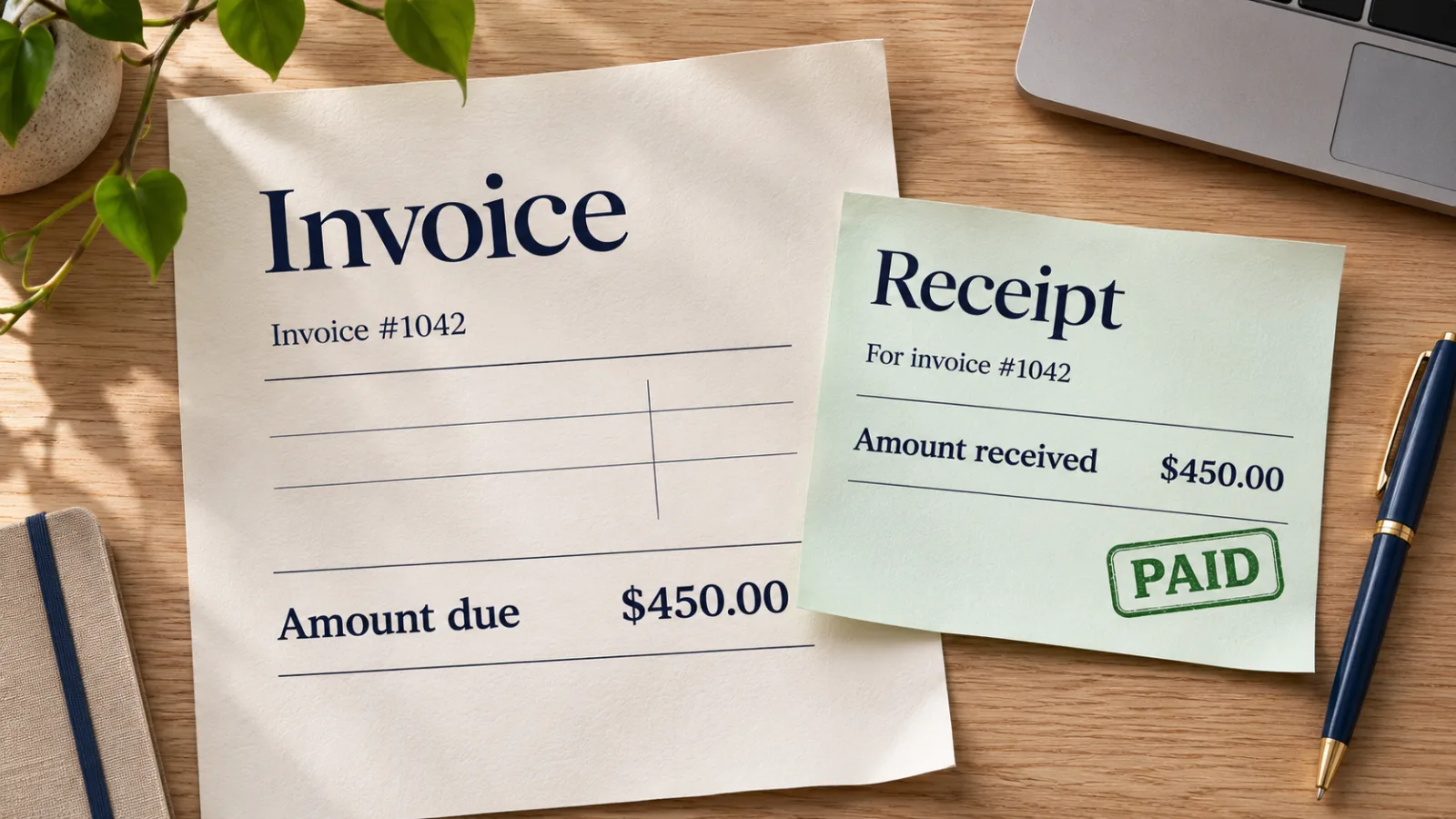
A client pays your invoice, then sends a quick email: "Can you send me a receipt?" You already sent an invoice. Isn't that the same thing?
Not quite. An invoice asks for payment. A receipt confirms the payment arrived. Same job, same client, two different moments, and often two different documents. If you need one right now, you can create a receipt PDF with our free generator, no account needed.
The short version
- An invoice is a request for payment. It goes out before the money arrives and shows what's owed and by when.
- A receipt is proof of payment. It goes out after the money arrives and shows what was paid, when and how.
- Paid on the spot? You usually skip the invoice and hand over a receipt.
- Paid later, on terms? You send an invoice first, then a receipt if the client wants one.
- Keep both. Tax authorities generally want to see what was charged and proof that it was paid.
Invoice vs receipt, side by side
|
Invoice |
Receipt |
|
|---|---|---|
|
Purpose |
Requests payment |
Confirms payment |
|
When it's issued |
Before payment |
After payment |
|
The key amount |
Amount due |
Amount received |
|
Dates shown |
Issue date and due date |
Payment date |
|
Payment method |
How to pay |
How it was paid |
|
Numbering |
Your invoice sequence |
Its own sequence, usually referencing the invoice |
|
What it records |
What the client owes |
That the client paid, in full or in part |
What goes on an invoice
An invoice carries your business details, the client's details, an invoice number, the issue date, a due date with payment terms, line items, any tax, the total due and how to pay. Our guide to what an invoice is walks through each field, and this one covers numbering.
What goes on a receipt
A receipt is shorter, because its job is narrower:
- Your business name and contact details, plus a tax registration number where your country requires one.
- A receipt number.
- The payment date.
- Who paid.
- What the payment was for: line items, or a reference to the invoice number.
- The amount received, with any tax shown on its own line.
- The payment method: card, bank transfer, check or cash.
- The balance remaining, if it was a partial payment.
Wording matters. A receipt says "Amount received" or "Paid", never "Amount due". A receipt that reads like a bill makes people wonder whether they still owe you money.
How the two fit together on a typical job
- Quote. The client agrees to the scope and price. Here's how a quote differs from an estimate and an invoice.
- Invoice. You bill the work, with terms such as Net 30.
- Payment. The client pays.
- Receipt. You confirm the payment and reference the invoice number.
Here's an example in US dollars. A designer sends invoice INV-0142 for $1,800 on Net 30 terms. The client pays $900 on day 10 and $900 on day 28. The designer issues two receipts. The first shows $900 received and a $900 balance; the second shows $900 received and a balance of zero. Both reference INV-0142, so anyone reconciling the account can match them in seconds.
Deposits follow the same pattern. Invoice the deposit, issue a receipt when it lands, then send a final invoice for the remaining balance that shows the deposit already paid.
Which one do you need? Common situations
|
Situation |
Invoice |
Receipt |
|---|---|---|
|
Project billed on payment terms |
Yes |
When the client asks, and always for cash |
|
Paid in full on the spot, at a market or on completion of a repair |
Usually not |
Yes |
|
Deposit before work starts |
Yes, for the deposit |
Yes, once it's paid |
|
Several partial payments |
One invoice showing the balance due |
One for each payment |
|
Client needs proof for a reimbursement or expense claim |
Shows the charge, not the payment |
Yes |
|
Cash payment |
Optional |
Always |
Cash is the case where a receipt matters most. Without one, neither of you has a record that money changed hands.
Can a paid invoice work as a receipt?
Often, yes. An invoice marked "Paid", with the payment date and method, shows both what was charged and that it was settled. Many clients accept it.
It isn't accepted everywhere, though. Some expense systems and reimbursement policies ask for a receipt specifically. When a client asks for one, send it; it takes a minute and saves an email chain.
The reverse matters for your own books. The IRS notes that proof of payment alone doesn't establish that you're entitled to a deduction. You should also keep documents, such as invoices, that show you incurred the cost.
Keep both for your records
In the US, the IRS says supporting documents for expenses should identify the payee, the amount paid, proof of payment, the date and a description showing it was a business expense. It adds that you may need a combination of documents to cover all of that, which usually means an invoice plus a receipt or bank record.
Travel has its own rule. For travel expenses, you generally need documentary evidence such as a receipt for all lodging and for any other expense of $75 or more.
How long to keep them? The IRS generally expects records that support income or a deduction to be kept for three years from the date you file the return that claims it, and some situations call for longer. Store invoices and receipts together, by year, so each payment sits next to the bill it settled.
Outside the US, the rules are set locally. Many countries with VAT or GST specify what a tax invoice must show before your customer can reclaim the tax. If you sell abroad or your clients reclaim tax, check your tax authority's requirements.
Mistakes to avoid
- Sending a receipt before payment clears. A check can bounce and a transfer can be reversed. Confirm the money is in your account first.
- Reusing the invoice number as the receipt number. Give the receipt its own number and reference the invoice.
- Leaving off the payment method. It's the first thing anyone checks when matching payments to a bank statement.
- Letting the amounts drift. Tax on the receipt should match the tax on the invoice it settles.
- Treating a quote or pro forma invoice as the bill. Neither one asks for payment the way an invoice does.
A few quick answers
Is a bill the same as an invoice or a receipt? A bill is another word for an invoice, seen from the side that has to pay it. It asks for money, so it isn't a receipt.
What is a sales receipt? It's the receipt you give when the sale and the payment happen at the same moment, at a counter or a market table. It lists what was sold and confirms payment in one document, so no invoice is needed.
Does a receipt need a signature? A signature isn't what makes a document a receipt; the payment details are. Some businesses still sign cash receipts by hand as an extra record of the handoff.
Is a bank or card statement enough? For proving that you paid, it can help. The IRS accepts certain account statements as proof of payment if they clearly show the amount, the payee and the date. A statement doesn't say what you bought, though, so keep the invoice or receipt as well.
Can I email a receipt as a PDF? Yes. A PDF keeps the layout fixed, is easy to file, and your client can forward it to whoever handles their expenses.
Where InvoiceCast fits
The free receipt generator creates a receipt PDF with no account. You can add up to 10 line items, pick a sales tax formula that appears on its own line, and choose from CAD, USD, EUR, GBP or AUD. Free use is limited to two PDFs a day. Prefer to fill something in yourself? Our receipt templates come in Excel and Word for a payment received, a cash sale and a receipt with sales tax.
On the billing side, the invoice generator works the same way. A free InvoiceCast account gives you unlimited invoices and clients, and the Pro and Business plans add receipts with their own numbering, along with quotes and recurring invoices.
Send the invoice, confirm the payment, and make the receipt.
Sources: IRS: what kind of records should I keep, IRS Publication 583, IRS Publication 463.
This article is general information, not tax or legal advice. Record-keeping and invoicing rules vary by country, so check your tax authority's current guidance or talk to a professional.