What Is an Invoice Number? How to Number Invoices (Examples)
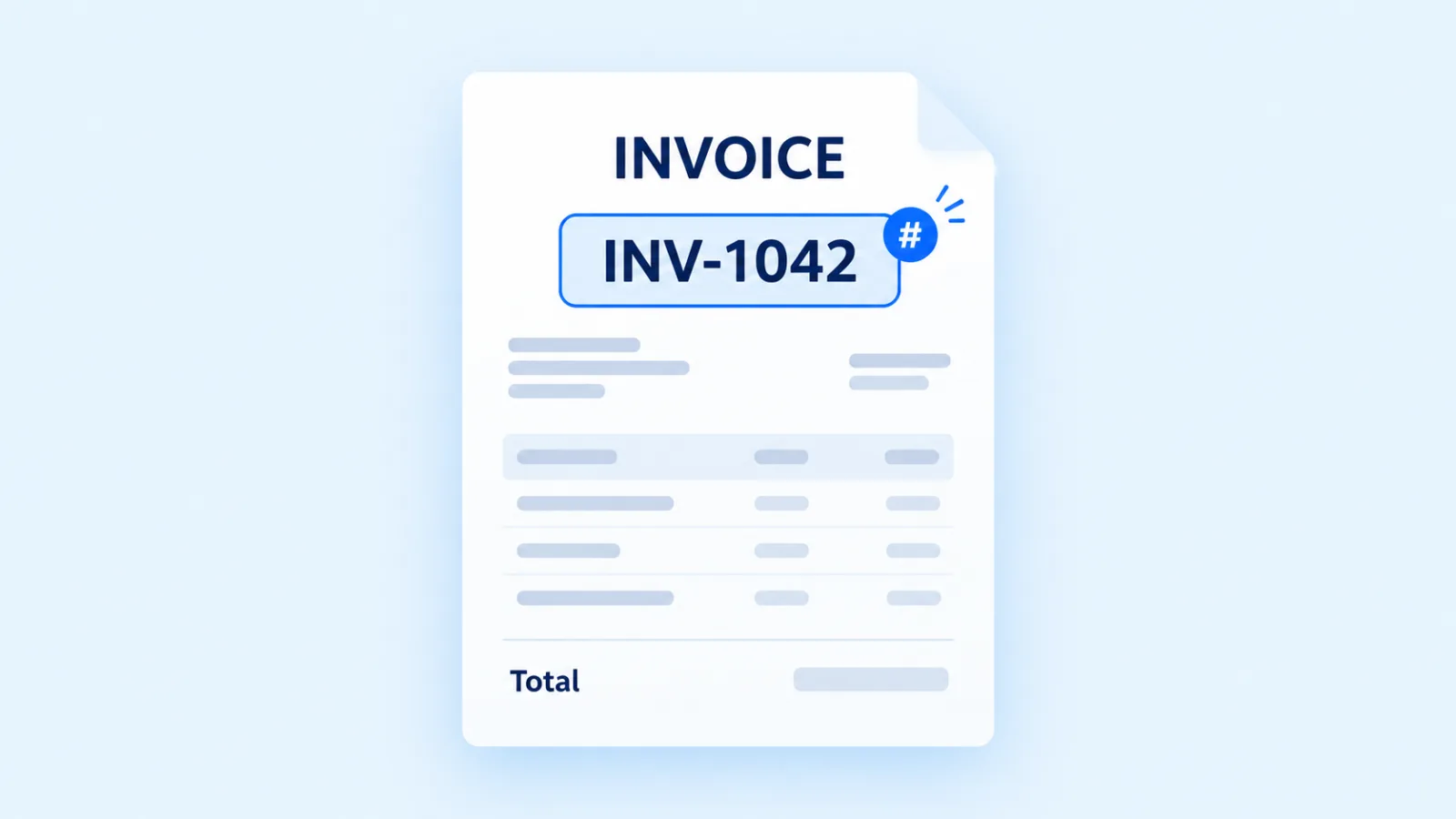
An invoice number is a unique identifier you assign to each invoice so it can be tracked, referenced and matched to a payment. Invoice numbers usually run in sequence (1041, 1042, 1043…), and once a number is used, it's never used again.
It looks like a small detail. It stops being small the day a client pays the same invoice twice, can't match your payment to anything, or an accountant asks why invoice #1037 is missing.
If you're new to invoicing, start with what an invoice is and what goes on one.
Why invoice numbers matter
- They prevent duplicate and missed payments. Your client's accounts payable team matches payments to invoice numbers. Two invoices with the same number, or none at all, is how payments go astray.
- They make follow-ups simple. "Invoice #1042 is now 10 days past due" is a lot clearer than "the invoice from last month for the website."
- They create an audit trail. A clean, unbroken sequence shows your income records are complete. In some jurisdictions, including countries under EU VAT rules, sequential invoice numbering is a legal requirement.
- They keep your own records sane. Searching, filing and reconciling all start with the number.
The four rules of invoice numbering
- Every number is unique. No two invoices share a number, ever.
- Numbers go up in sequence. Each new invoice gets the next number.
- Never reuse or recycle a number, even if an invoice was cancelled or sent by mistake.
- Pick one format and stick to it. Changing formats midway makes records harder to follow.
Gaps aren't a disaster, but an unexplained one is the first thing an auditor asks about. If you cancel an invoice, keep its number on file as cancelled rather than deleting it.
5 invoice number formats, with examples
| Format | Example | Good for | Trade-off |
|---|---|---|---|
| Simple sequential | 1001, 1002, 1003 | Freelancers and small businesses | Says nothing about the date or client |
| Prefix + sequence | INV-1042 | Telling invoices apart from quotes, receipts and POs | Slightly longer |
| Date + sequence | 2026-10-001 | Seeing at a glance when an invoice was issued | The sequence often restarts each year or month, which you must handle consistently |
| Client code + sequence | ACME-007 | Agencies and consultants with a few large clients | Harder to keep one overall sequence |
| Project code + sequence | WEB24-03 | Long projects billed in stages | Can get messy across many projects |
Our recommendation for most small businesses: a short prefix plus a sequential number, like INV-1042. It's readable, it sorts correctly, and it can't be confused with a quote or a receipt.
Should you start at 1?
You can start anywhere. Many businesses start at 1001 or 100 so their numbers look consistent and don't reveal how many invoices they've sent. That's fine, as long as you count upward from there without skipping or reusing numbers.
Where the invoice number goes
- At the top of the invoice, near the date, clearly labelled "Invoice #" or "Invoice No."
- In the email subject line when you send it, for example "Invoice #1042 from Your Business, due Oct 31." Our guide on how to send an invoice has email templates that do this.
- In the PDF file name:
Invoice-1042-YourBusiness.pdf. - As the payment reference. Ask clients to include it when they pay so you can match the payment instantly.
Invoice number vs. other numbers
- Purchase order (PO) number: issued by your client to authorize the purchase. Put it on your invoice if they gave you one (many corporate clients reject invoices without it), but it's not your invoice number.
- Quote or estimate number: belongs to the document you sent before the work. Use a different prefix, like Q-, so the two sequences don't collide.
- Receipt number: confirms a payment you received. It should have its own sequence too.
- Account or customer number: identifies the client, not the invoice.
Made a mistake? Don't reuse the number
If an invoice went out with an error:
- Not yet sent: fix it. The number stays the same.
- Already sent: don't edit it silently and don't delete it. Cancel it (or issue a credit note against it) and send a corrected invoice with the next number. Reference the original number on the new invoice so your client's accounts team can follow what happened.
Reusing a number to "replace" an invoice is how two different documents end up with the same ID in someone's records.
Switching invoicing tools
When you move from spreadsheets or another tool, continue your existing sequence rather than restarting at 1. If your last invoice was #1187, your next one should be #1188, whatever software created it. Keep your old invoices archived; they're part of the same record.
How InvoiceCast numbers your invoices
You don't have to track any of this by hand:
- Every invoice gets the next number automatically, in sequence, unique to your account.
- Add your own prefix in your account settings if you want your initials or business code in front of every number.
- Quotes have their own sequence with a Q- prefix. When a client approves a quote or estimate and you convert it, the new invoice takes the next invoice number, so your invoice sequence stays unbroken.
- Receipts are numbered separately with an RCP- prefix (Pro and Business plans).
- Recurring invoices are numbered the same way as any other invoice when each one is generated.
Creating one-off invoices without an account? The free invoice generator and our invoice templates both include an invoice number field; just keep your own sequence. When you're ready to stop counting, the Free plan includes unlimited invoices.
FAQ
Is an invoice number required by law?
It depends where you do business. In the US there's no federal rule requiring invoice numbers, but they're standard practice and your clients will expect them. Under EU VAT rules, a unique sequential number is mandatory. Either way, numbering every invoice is the safe default.
Can two invoices have the same number?
No. Each invoice number should be used exactly once. Duplicates cause payment-matching errors and raise questions in an audit.
Can I change an invoice number after sending the invoice?
Avoid it. Your client may already have recorded the original number. Cancel the original or issue a credit note, then send a new invoice with the next number.
What's the difference between an invoice number and a PO number?
You create the invoice number to identify your invoice. Your client creates the PO number to authorize the purchase. When a client gives you a PO number, include it on the invoice alongside your own number.
Should invoice numbers include the year?
Only if it helps you. Date-based formats like 2026-10-001 are easy to read, but you need a consistent rule for what happens at year-end. A simple prefix plus a continuous sequence avoids the question entirely.
Let numbering take care of itself. InvoiceCast numbers every invoice, quote and receipt in its own sequence automatically. Start free →
Last updated October 2026.