Quote vs Estimate vs Invoice: What's the Difference?
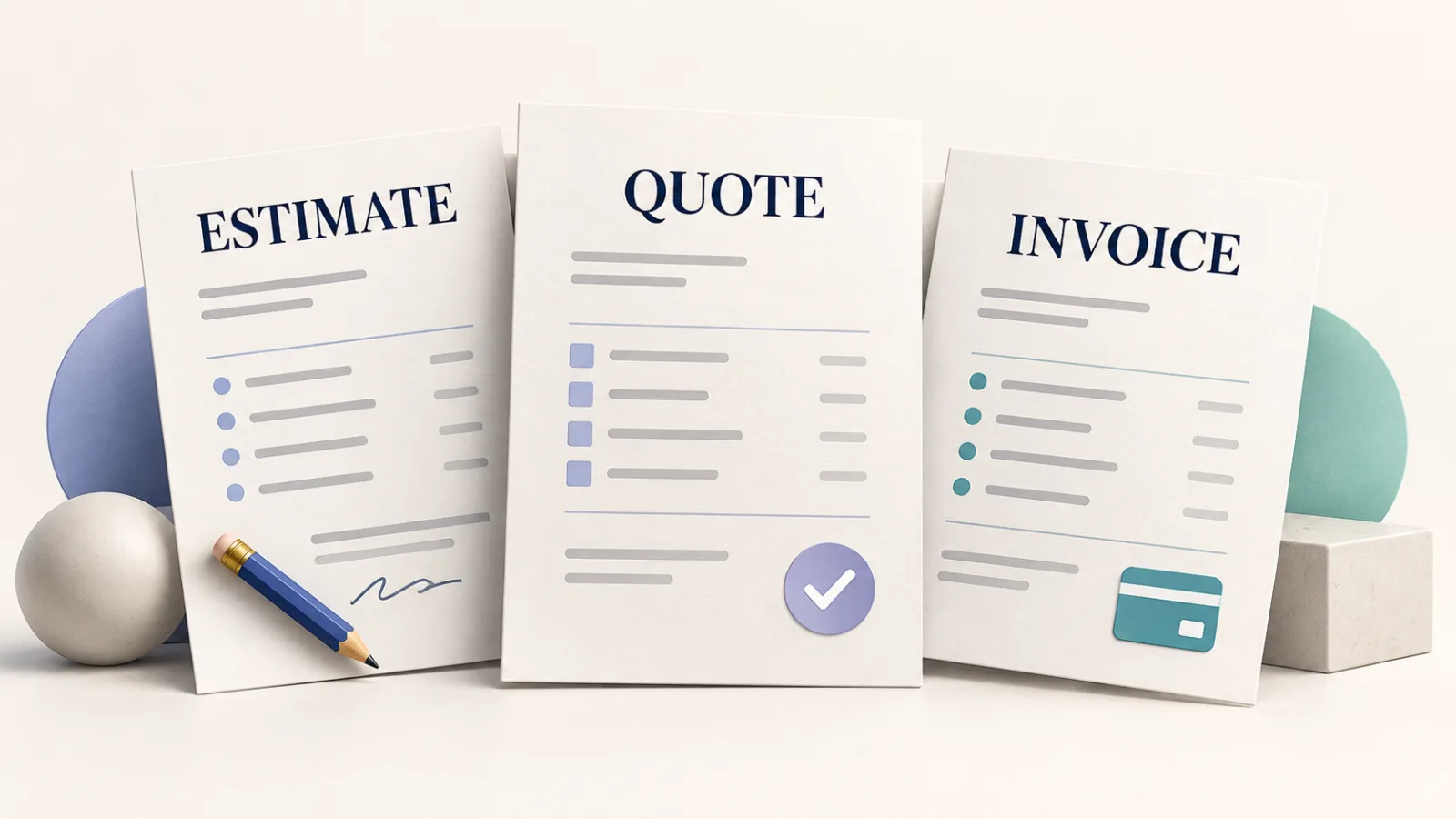
An estimate is an approximate price before the work, a quote is a fixed price before the work, and an invoice is a request for payment after (or during) the work. They often look almost identical, which is why they get mixed up. What differs is what each one promises.
Getting this right prevents the most common billing dispute there is: "but you said it would cost…"
The quick comparison
| Estimate | Quote | Invoice | |
|---|---|---|---|
| What it says | "It'll probably cost around this." | "It will cost exactly this." | "Please pay this amount." |
| When you send it | Before the work, when scope is uncertain | Before the work, when scope is clear | After the work, or at agreed milestones |
| Is the price fixed? | No, it can change as work progresses | Yes, for the scope and period stated | Yes, it's the final amount |
| Does the client owe money? | No | Not until they accept and you deliver | Yes, by the due date |
| Has an expiry date? | Sometimes | Usually ("valid for 30 days") | No; it has a due date instead |
| Counts as income? | No | No | Yes, it's part of your sales records |
What is an estimate?
An estimate is your best guess at the cost before you start. Use it when you can't know the full scope yet: a renovation where you haven't opened the walls, a software project with unclear requirements, consulting billed by the hour.
Good estimates:
- give a range or a clearly approximate figure ("$3,000–$3,800");
- list the assumptions behind the number;
- say what would change it, and how you'll tell the client before it does.
An estimate isn't a promise. But if the final bill lands far above it with no warning, expect a difficult conversation.
What is a quote?
A quote (or quotation) is a fixed price for a defined scope. Once the client accepts it, both sides are expected to stick to it. Many businesses treat an accepted quote as part of the agreement, so write it with care.
A good quote includes:
- a quote number and date;
- a precise scope of work: what's included and, just as important, what isn't;
- line items with quantities and prices;
- taxes, if they apply;
- a validity period ("valid until November 25");
- payment terms, including any deposit;
- how the client accepts it: a signature, a reply or an approval.
If the client asks for more than the quote covers, send a revised quote or a change order before doing the extra work, not an invoice afterward.
Is a quote legally binding?
It depends on where you are and what the documents say. In many places an accepted quote can form part of a contract. Treat any quote you send as a price you're prepared to honor, and get professional advice if the stakes are high.
Quote vs. estimate: which should you send?
- Send an estimate when the scope is uncertain, or when the client just wants a ballpark to plan a budget.
- Send a quote when the scope is clear and the client needs a firm number to approve, such as for a purchase order.
Terminology varies by industry and region. Some trades use "estimate" for what is really a fixed quote. Whichever word you use, state clearly on the document whether the price is fixed or approximate.
What is an invoice?
An invoice comes after the quote or estimate. It requests payment for work that was delivered or for an agreed milestone, with a due date and payment instructions. Unlike a quote, it's a record of a sale, and the amount is owed. For the full breakdown, see what an invoice is and what goes on one.
What about a pro forma invoice?
A pro forma invoice is a preliminary document sent before delivery, often for customs, financing or internal approvals. It looks like an invoice but isn't a demand for payment, so in practice it plays a role closer to a detailed quote.
From quote to invoice without retyping
The cleanest workflow:
- Send a quote with a clear scope, price and expiry date.
- Get approval in writing.
- Do the work, or bill a deposit up front if you agreed to one.
- Convert the approved quote into an invoice. The line items carry over, so the invoice matches exactly what the client approved.
- Send the invoice with a due date and a way to pay. Our guide on how to send an invoice has email templates.
Keep quotes and invoices in separate number sequences (Q-0042 for the quote, INV-1042 for the invoice) so they're never confused. Here's how to number invoices.
Quotes and invoices in InvoiceCast
In InvoiceCast, quotes and estimates live alongside your invoices:
- each quote gets its own Q- number and an expiry date;
- quotes use the same line items, taxes and branding as your invoices;
- when the client approves, you convert the quote to an invoice in one click, and it takes the next invoice number, so your invoice sequence stays unbroken.
Quotes are available on Pro and higher plans; invoices are unlimited on the Free plan. Just need a one-off document right now? Use the free invoice generator or our invoice templates.
Common mistakes
- Calling an estimate a quote, or the reverse. Label the document for what it is.
- No expiry date on a quote. Prices and availability change; a quote accepted six months later shouldn't bind you to old rates.
- Vague scope. Most disputes come from what the quote didn't say.
- Doing extra work without a revised quote. Get approval first, then bill it.
- Invoicing a different amount than the approved quote without explaining why.
FAQ
Is a quote the same as an invoice?
No. A quote proposes a price before the work; an invoice requests payment after it. A quote doesn't mean money is owed; an invoice does.
Can an estimate change?
Yes, that's the point of an estimate. Tell your client as soon as you expect the final cost to differ, and get their approval before going significantly over.
Do I need a quote before every invoice?
No. For small or repeat jobs, many businesses go straight to an invoice. Quotes are most useful for new clients, larger projects and anyone who needs a firm number to approve.
Should a quote include sales tax?
Yes, if the work is taxable where you are. Show the tax separately so the total matches the invoice that follows.
How long should a quote be valid?
Commonly 15 to 30 days. Choose a period that reflects how quickly your costs and availability change.
Quote it, win it, invoice it, without retyping a thing. Start free with InvoiceCast →
This article provides general information, not legal advice. Last updated October 2026.