1099 vs W-2: Contractor or Employee?
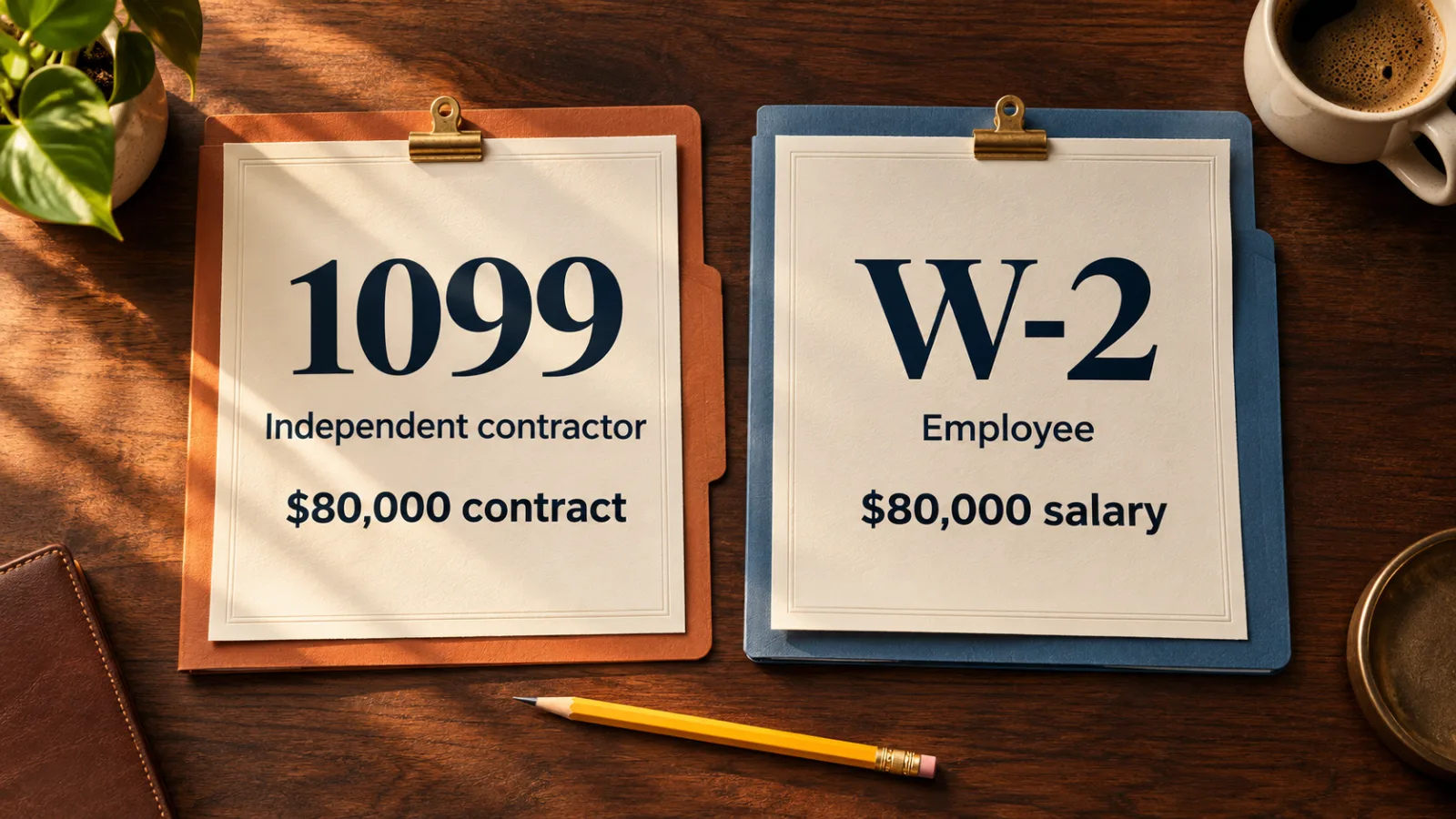
You have two offers. One is a W-2 job at $80,000. The other is a 1099 contract at $80,000. They look identical until tax season, when the contract can cost you several thousand dollars more, before you've paid for health insurance or a single day off.
The difference between 1099 and W-2 is more than a tax form. It changes who pays what, what protections you have, and how you get paid. And the label on the offer doesn't settle which one you really are.
The short version
- W-2 means you're an employee. Your employer withholds taxes from each paycheck and pays half of your Social Security and Medicare.
- 1099 usually means you're an independent contractor. Nothing is withheld, and you pay both halves of those taxes yourself.
- The form doesn't decide your status. The IRS looks at how much control the business really has over the work.
- For 2026 payments, a business only has to issue Form 1099-NEC at $2,000 or more. Income below that is still taxable.
- Matching a W-2 salary takes a higher rate. Our freelance rate calculator works out what to charge from the income you want to keep.
1099 vs W-2, side by side
|
W-2 employee |
1099 contractor |
|
|---|---|---|
|
Income tax |
Withheld from each paycheck |
You pay it, usually through quarterly estimates |
|
Social Security and Medicare |
7.65% from you, 7.65% from your employer |
15.3% from you, on 92.35% of net earnings |
|
Year-end form |
Form W-2 |
Form 1099-NEC, if paid $2,000 or more in 2026 |
|
Where income is reported |
Wages on Form 1040 |
Schedule C, with Schedule SE for self-employment tax |
|
Work expenses |
Usually covered by your employer, or paid out of pocket |
Ordinary and necessary business expenses reduce your profit |
|
How you get paid |
Payroll |
Your invoices |
|
Who controls the work |
Your employer |
You, within the agreed scope |
How the IRS decides: control, not paperwork
For federal employment taxes, common law rules apply. The IRS looks at all the evidence of control and independence in the relationship, and sorts it into three categories.
|
Category |
Points toward employee |
Points toward contractor |
|---|---|---|
|
Behavioral control |
The business tells you how, when and where to do the work, or trains you in its methods |
You choose your own methods and are judged on results |
|
Financial control |
The business supplies the tools and reimburses expenses, you work only for them, and you're paid a steady wage |
You invest in your own tools, carry unreimbursed costs, market to other clients, and can make a profit or a loss |
|
Relationship of the parties |
You get benefits like insurance or paid leave, the work is open-ended, and it's a key part of the company's regular business |
A written contract covers a defined project, with no employee-type benefits |
No single answer settles it. A contractor can work on-site, and an employee can work from home. What counts is the overall picture.
Try this quick check. The more of these are true, the more the arrangement looks like employment:
- You have set hours or a manager who assigns your daily tasks.
- This client is your only source of work, and you aren't free to take others.
- You use the company's laptop, email address and systems.
- The work has no end date.
- You couldn't send someone else to do it.
A contract that says "independent contractor" helps show what both sides intended, but it can't override how the work actually runs.
Other tests can give a different answer
The IRS test covers federal employment taxes. Other laws use their own.
The U.S. Department of Labor applies an "economic reality" test for minimum wage and overtime, asking whether you depend on the business for work or are really in business for yourself. It proposed changes to that test in February 2026.
Some states are stricter. In California, the ABC test presumes that most workers are employees unless the hiring business proves three things: the worker is free from its control, the work is outside its usual business, and the worker has an independently established trade. So you could fit the IRS definition of a contractor and still be an employee under state law.
What 1099 really costs: a worked example
Take $80,000 in both cases, and leave income tax aside.
|
2026 example |
W-2 employee |
1099 contractor |
|---|---|---|
|
Earnings |
$80,000 in wages |
$80,000 in net profit |
|
Amount subject to the tax |
$80,000 |
$73,880 (92.35%) |
|
Rate paid by you |
7.65% |
15.3% |
|
Social Security and Medicare you pay |
$6,120.00 |
$11,303.64 |
The contractor pays $5,183.64 more. Half of the self-employment tax, $5,651.82 here, is deductible when you work out income tax, which softens the gap but doesn't close it. The 12.4% Social Security portion applies only up to the 2026 wage base of $184,500.
The bigger gap is often hours. A salary of $80,000 over 2,080 hours is about $38.46 an hour. A contractor doing 30 billable hours for 40 weeks bills 1,200 hours, so reaching the same $80,000 takes $66.67 an hour. That's before software, insurance, retirement savings and the extra tax above. Clients don't pay for the time you spend on sales, admin or vacation.
So a 1099 rate only compares with a W-2 salary after those costs. Put your own numbers into the rate calculator before you accept or quote.
If you're on a 1099: five habits to start now
- Expect to fill out a W-9. Clients use Form W-9 to collect your taxpayer details, usually before the first payment.
- Invoice every job. With the $2,000 reporting threshold, small clients may never send a form. Your numbered invoices become your income record. It takes a minute with the free invoice generator.
- Pay estimated taxes. You generally have to if you expect to owe $1,000 or more when you file. The last 2026 payment is due January 15, 2027.
- Track expenses as you go. Self-employment tax applies to your profit, not your revenue. If net earnings are $400 or more, you generally owe it.
- Log your hours if you bill by the hour. The timesheet calculator totals a week or two of start times, end times and breaks, and a clean approval process keeps invoices from being disputed.
Working through an agency or your own company? Our IT contractor guide covers W-2 through an agency, 1099 and corp-to-corp setups.
If you think you've been misclassified
Businesses can't choose a status for convenience. A business that treats an employee as a contractor is generally liable for the employment taxes it should have withheld and paid.
Either the worker or the business can file Form SS-8 and ask the IRS to decide, though a determination may take at least six months. Workers can use Form 8919 to report uncollected Social Security and Medicare tax in certain situations. Businesses that want to reclassify workers can look at the IRS Voluntary Classification Settlement Program. State agencies have their own complaint processes.
If you're hiring: decide before the first payment
Run the three-category test for each role, and write down why you reached your answer. Then collect a W-9 from each contractor before you pay them. Forms 1099-NEC for 2026 payments of $2,000 or more are due Monday, February 1, 2027, because January 31 falls on a Sunday.
If your workers look like employees under the test, a contract won't fix that. Payroll will.
A few quick answers
Is 1099 better than W-2? Neither is better in general. W-2 gives you withholding and often benefits. A 1099 gives you more control, deductions and possibly a higher rate, if you price it correctly.
Can I be both? Yes. You can hold a W-2 job and run a 1099 business on the side. Your wages and net self-employment earnings count together toward the Social Security wage base.
What if I don't get a 1099? You still report the income. The form is a reporting requirement for the payer, and it doesn't determine what you owe.
Does a 1099 prove I'm a contractor? No. It shows how the payer reported the money. The working relationship determines your status.
Where InvoiceCast fits
On a W-2, payroll handles the paperwork. On a 1099, your invoices do that job. Our no-account invoice tool gets one out the door in a couple of minutes.
A free InvoiceCast account keeps unlimited invoices and clients in one place, with PDF download. If you hire contractors, the Business plan adds contractor management, timesheet approval and invoices generated from approved timesheets.
Know which side of the line you're on, price it accordingly, and send your next invoice.
Sources: IRS Topic 762, IRS: independent contractor or employee, IRS Topic 554, IRS Topic 751, Publication 15, Publication 334, Publication 1099, IRS: estimated taxes, U.S. Department of Labor proposed rule, California: ABC test FAQ.
This article is general information, not tax or legal advice. Rules and figures change, so check current IRS and state guidance or talk to a tax professional.